Spinal Meningeal Tension tests
Image


Pre-requisite – you must be able to bend forward and comfortably touch your toes with straight legs. If you are unable to do so you know your spinal tension is too high. In this case you will measure your number 1 distance (as per the above picture) and monitor this.
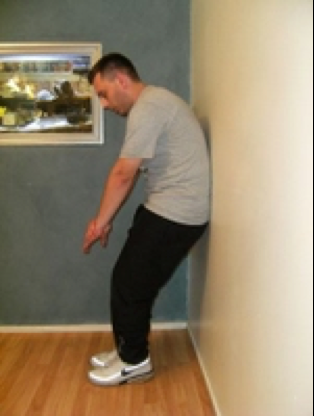
If you can bend forward, straight legs and touch your toes. Then do so against the wall. When you are against the wall, your heels and buttocks must be in contact with the wall the entire time. Your forward flexion must be controlled and slow.
If, while against the wall, you can bend forward and touch your toes, slowly and controlled, with your buttocks and heels still in contact with the wall…then you have no spinal tension and your body is adaptable.
Most people will feel how much their calf muscles wish to push them onto their toes. This is the start of the tension and it goes through the entire back-line of the body. So measure, as in the picture number 2, how far from the wall you have to bring your heels in order to complete the forward flexion smartly?
Rules:
If there are any concerns, visit your family Chiropractor.

Sit flat on the floor with your legs straight in front of you and your feet flat on the wall. Your heels and your toes must be in contact with the wall and your knees are straight.
Your first goal is to get your spine vertical and straight as in the red “line 1”. For most people this will be very difficult and there will be a small backward rounding of the lower spine. This indicates that you have significant spinal tension.
If you can achieve this, as in this picture, then you measure “distance 2”. With your arms in front of you, and maintaining the straight back how far to the wall can you reach your fingertips? Ideally you should be able to touch the wall in front. The distance from the wall is the amount of spinal tension protecting and compensating for you.
Rules:
If there are any concerns, visit your family Chiropractor.
© 2019. Aspire Happyness Chiropractic.
All rights reserved. Privacy policy



Website designed, developed & maintained by BahatiGroup