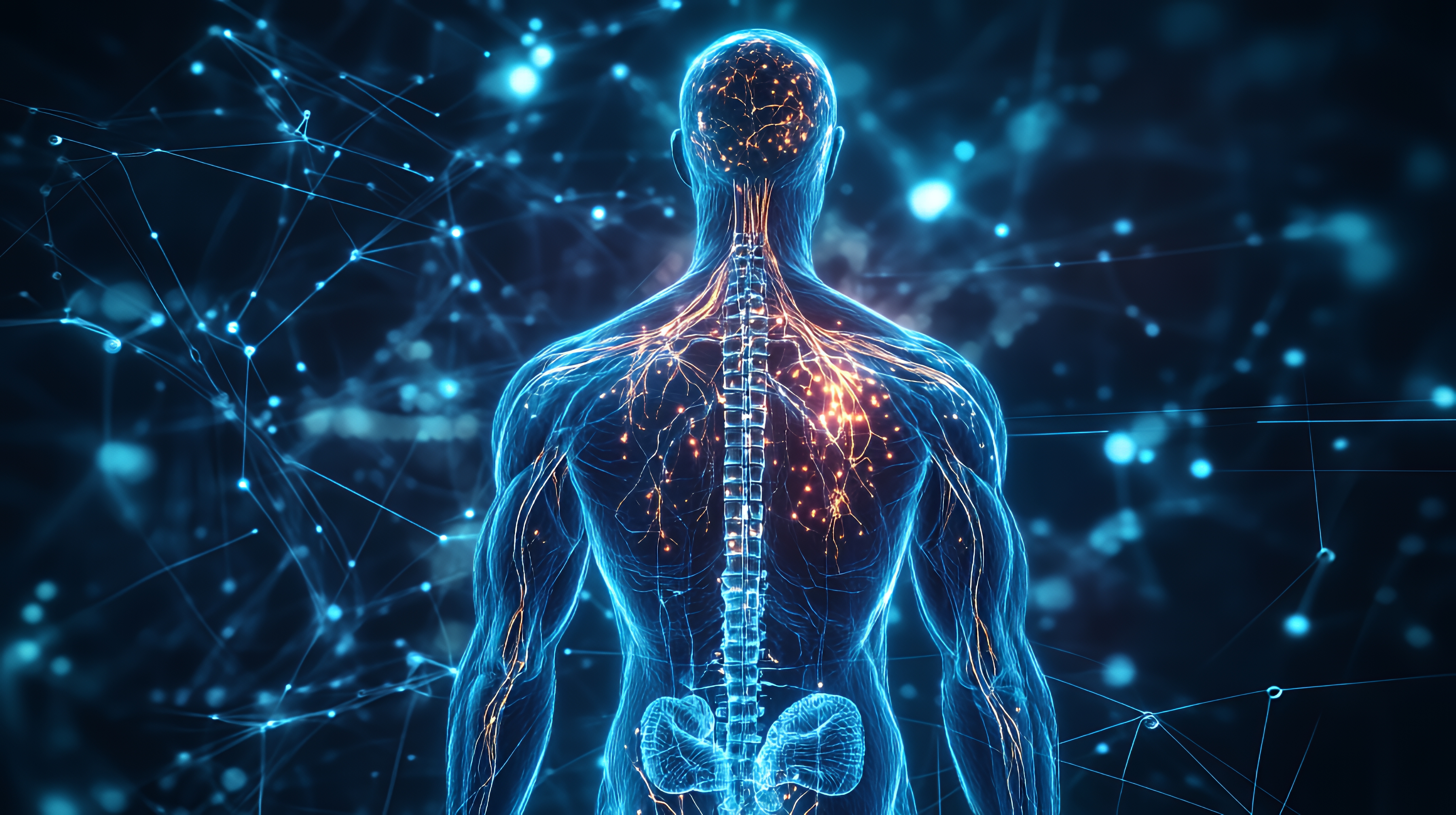
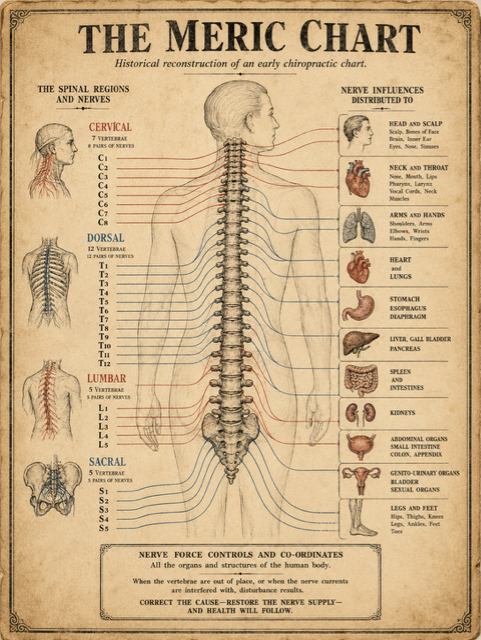
The Meric chart is a traditional chiropractic model used to illustrate the neurological relationships between different areas of the spine and the organs, muscles and tissues of the body.
In simple terms, the chart proposes that the spine and the rest of the body do not function as separate systems. The vertebrae, spinal joints, muscles, spinal cord, brain and internal organs communicate through an interconnected nervous system.
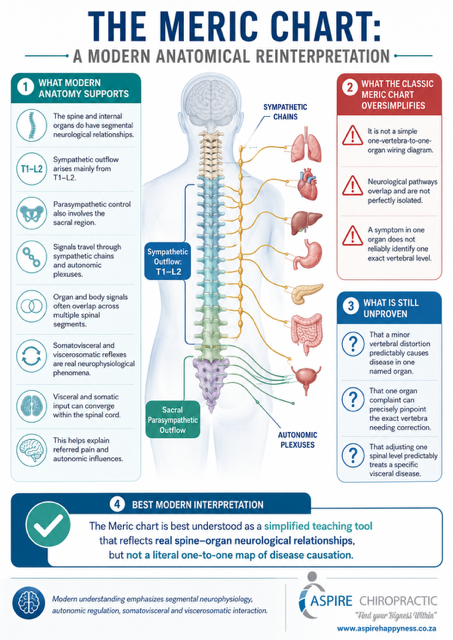
This does not mean that one vertebra directly controls one organ, or that adjusting a particular spinal level will treat a specific internal disease. The relationship is far more complex. However, the Meric chart remains an important historical starting point for understanding how spinal function may influence neurological regulation throughout the body.
The historical development of the Meric chart
Chiropractic was founded by D.D. Palmer in 1895. From the early years of the profession, Palmer observed that patients appeared to experience changes beyond local neck or back discomfort following spinal adjustments.
His early accounts included:
- Harvey Lillard’s hearing difficulty, which Palmer associated with an abnormality in the upper thoracic region;
- heart-related symptoms associated with another spinal level; and
- other health complaints linked to different areas of the spine.
These early observations led chiropractic pioneers to investigate the connections between spinal segments, spinal nerves and different areas of the body. They noted that the body was divided into neurological zones associated with individual pairs of spinal nerves. These zones included the muscles, skin and internal organs believed to share related segmental nerve pathways. This system eventually became known as the Meric system.
What was the Meric system?
The Meric system became a structured clinical method taught at the Palmer School of Chiropractic. A patient’s symptoms or diagnosed condition were used to identify the potentially related neurological “mere,” or spinal segment. The chiropractor would then examine the corresponding areas of the spine using methods such as:
- palpation;
- tenderness;
- muscular tension;
- changes in spinal contour or alignment;
- nerve tracing; and
- later, spinal radiography, historically called spinography.
The early clinical sequence was broadly understood as: Identify the symptom or organ disturbance → determine the associated nerve supply → examine the related spinal region → identify the suspected subluxation → adjust the segment → allow the body to begin its process of adaptation, self-regulation and healing. This model reflected the early chiropractic belief that improving spinal and neurological function could support the body’s natural ability to regulate itself. A great foundation for how Chiropractic works today!
Henry Winsor and the 1921 cadaver study
In 1921, American medical doctor Henry Winsor published an observational cadaver study examining whether internal-organ disease was associated with vertebral abnormalities at spinal levels sharing similar sympathetic nerve supply.
His research was independent of the development of the Meric system. However, the reported findings were later used by chiropractors to support the idea of vertebral sympathetic–visceral relationships.
Winsor’s paper is historically interesting, but it must be interpreted carefully. It was:
- an observational cadaver report;
- not a modern controlled clinical trial;
- unable to establish whether spinal changes caused organ disease;
- unable to determine whether organ disease contributed to spinal changes; and
- not evidence that adjusting a particular vertebra would treat a specific internal condition.
The most responsible interpretation is that Winsor reported an anatomical association.
What modern anatomy tells us
Modern anatomy confirms that the musculoskeletal, sensory and visceral systems have segmentally organised neurological relationships. However, these relationships do not usually follow a simple one-vertebra-to-one-organ pattern.
A modern neurological interpretation should consider:
- the vertebral and spinal region;
- the approximate spinal cord level;
- sympathetic outflow, primarily from T1–L2;
- sympathetic chains and autonomic plexuses;
- sacral parasympathetic pathways;
- overlapping sensory, visceral and autonomic pathways;
- convergence of somatic and visceral input within the spinal cord;
- viscerosomatic and somatovisceral reflexes;
- referred pain;
- brain and autonomic modulation of the body’s response.
This broader model is better described as segmental neurophysiological interaction.
The spine as a source of neurological information
The joints, muscles and connective tissues of the spine continuously send sensory information to the brain.
This information helps the nervous system understand:
- body position;
- movement;
- muscular tension;
- physical load;
- postural demand;
- pain or threat;
- balance and coordination.
When spinal movement is altered, the quality of the sensory information reaching the brain may also change.
Research by Dr Heidi Haavik and colleagues suggests that chiropractic spinal adjustments can produce measurable, short-term changes in the way the brain processes sensory information and organises movement, muscle control and sensorimotor integration. This does not mean that an adjustment permanently rewires the brain. It suggests that an adjustment acts as a focused neurological stimulus that may temporarily influence how the nervous system processes information and adapts its output.
The role of the autonomic nervous system
The brain communicates with the internal organs through the autonomic nervous system, or ANS.
The ANS helps regulate automatic functions such as:
- heart rate;
- blood pressure;
- breathing;
- digestion;
- temperature regulation;
- pupil responses;
- stress physiology; and
- recovery and adaptation.
Sensory information from the spine enters spinal cord and brain networks that also participate in autonomic regulation. This provides a possible neurological pathway through which spinal sensory input may influence the way the nervous system responds to physical demand, stress and changes in the body.
Some early research has reported short-term changes in measures associated with autonomic activity following spinal manipulation.
A modern understanding of the Meric chart
The most balanced modern interpretation is:
The spine is an important source of sensory information within a larger neurological communication network involving the spinal cord, brain, muscles, autonomic nervous system and internal organs.
A chiropractic adjustment provides focused sensory input into this network. This may help the nervous system reassess incoming information and adapt its motor and regulatory responses.
The individual response will depend on many factors, including:
- the person’s current health;
- stress and allostatic load;
- pain and inflammation;
- movement patterns;
- nervous-system sensitivity;
- sleep and recovery;
- previous injury; and
- the broader clinical context.
Why this still matters
The early Meric chart was limited by the anatomical knowledge and research methods available at the time. Yet its central message remains relevant: the spine is not isolated from the rest of the body.
Modern neuroscience is helping us understand that the relationship between the spine, brain, autonomic nervous system and body is dynamic, overlapping and adaptable. As research advances, we hope to gain a clearer understanding of how spinal function influences sensory processing, movement, autonomic regulation and whole-body adaptation.
“The doctor of the future will give no medicine, but will interest his patients in the care of the human frame, in diet, and in the cause and prevention of disease.” — commonly attributed to Thomas A. Edison
References
- Palmer DD. The Chiropractor’s Adjuster: The Science, Art and Philosophy of Chiropractic. Portland, OR: Portland Printing House Company; 1910.
- Palmer BJ. The Science of Chiropractic: Its Principles and Adjustments. Davenport, IA: Palmer School of Chiropractic; 1906.
- Palmer BJ. The Chiropractor’s Adjuster. Vol 4. Davenport, IA: Palmer School of Chiropractic; 1908.
This early Palmer text included diseases and conditions alongside corresponding vertebral areas of adjustment based on the Meric system.
- Palmer BJ. The Philosophy, Science and Art of Chiropractic Nerve Tracing. Vol 6. Davenport, IA: Palmer School of Chiropractic; 1911.
This volume illustrated nerve tracing according to the Meric system.
- Vernon H. Historical overview and update on subluxation theories. J Chiropr Humanit. 2010;17(1):22–32. doi:10.1016/j.echu.2010.10.004.
This historical review describes the development of the Meric system by B.J. Palmer and James C. Wishart and the later movement from static vertebral misalignment toward joint dysfunction and neurological reflex models.
- Winsor H. Sympathetic segmental disturbances—II: The evidences of the association, in dissected cadavers, of visceral disease with vertebral deformities of the same sympathetic segments. Medical Times. 1921;49:267–271.
This is a historical observational cadaver report and should not be interpreted as proof of causation or treatment effectiveness.
- Haavik-Taylor H, Murphy B. Cervical spine manipulation alters sensorimotor integration: a somatosensory evoked potential study. Clin Neurophysiol. 2007;118(2):391–402. doi:10.1016/j.clinph.2006.09.014.
- Haavik-Taylor H, Murphy B. Altered sensorimotor integration with cervical spine manipulation. J Manipulative Physiol Ther. 2008;31(2):115–126. doi:10.1016/j.jmpt.2007.12.011.
- Haavik Taylor H, Murphy B. The effects of spinal manipulation on central integration of dual somatosensory input observed after motor training: a crossover study. J Manipulative Physiol Ther. 2010;33(4):261–272. doi:10.1016/j.jmpt.2010.03.004.
- Lelic D, Niazi IK, Holt K, Jochumsen M, Dremstrup K, Yielder P, Murphy B, Drewes AM, Haavik H. Manipulation of dysfunctional spinal joints affects sensorimotor integration in the prefrontal cortex: a brain source localization study. Neural Plast. 2016;2016:3704964. doi:10.1155/2016/3704964.
- Haavik H, Niazi IK, Jochumsen M, Sherwin D, Flavel S, Türker KS. Impact of spinal manipulation on cortical drive to upper and lower limb muscles. Brain Sci. 2017;7(1):2. doi:10.3390/brainsci7010002.
- Haavik H, Niazi IK, Jochumsen M, Uginčius P, Sebik O, Yılmaz G, Navid MS, Özyurt MG, Türker KS. Chiropractic spinal manipulation alters TMS-induced I-wave excitability and cortical silent period duration. Neural Plast. 2018;2018:5027093. doi:10.1155/2018/5027093.
- Haavik H, Kumari N, Holt K, Niazi IK, Amjad I, Pujari AN, Türker KS, Murphy B. The contemporary model of vertebral column joint dysfunction and impact of high-velocity, low-amplitude controlled vertebral thrusts on neuromuscular function. Eur J Appl Physiol. 2021;121:2675–2720. doi:10.1007/s00421-021-04727-z.
- Holt KR, Haavik H, Lee AC, Murphy B, Elley CR. Effectiveness of chiropractic care to improve sensorimotor function associated with falls risk in older people: a randomized controlled trial. J Manipulative Physiol Ther. 2016;39(4):267–278. doi:10.1016/j.jmpt.2016.02.003.
- Sato A, Sato Y, Schmidt RF. The Impact of Somatosensory Input on Autonomic Functions. Reviews of Physiology, Biochemistry and Pharmacology. Vol 130. Berlin: Springer; 1997.
- Jänig W. The Integrative Action of the Autonomic Nervous System: Neurobiology of Homeostasis. Cambridge: Cambridge University Press; 2006.
- Jänig W. Physiology and pathophysiology of visceral pain. Schmerz. 2002;16(6):429–446.
- Malykhina AP. Neural mechanisms of pelvic organ cross-sensitization. Neuroscience. 2007;149(3):660–672. doi:10.1016/j.neuroscience.2007.07.053.
- Welch A, Boone R. Sympathetic and parasympathetic responses to specific diversified adjustments to chiropractic vertebral subluxations of the cervical and thoracic spine. J Chiropr Med. 2008;7(3):86–93. doi:10.1016/j.jcm.2008.04.001.
- Kingston L, Claydon L, Tumilty S. The effects of spinal mobilizations on the sympathetic nervous system: a systematic review. Man Ther. 2014;19(4):281–287. doi:10.1016/j.math.2014.04.004.
- Gera C, Malik M, Kaur J, Saini M. A systematic review and meta-analysis on the effect of spinal mobilization and manipulation on cardiovascular responses. Hong Kong Physiother J. 2020;40(2):75–87. doi:10.1142/S1013702520500070.